From Nahariya to Tefen to Haifa:
The Story of Yisrael Shiloni and the Archive for German-speaking Jewry in Israel (the “Yekkes Archive”)
Dr. Irit Chen
In June 1970, Yisrael Shiloni, a Berlin-born Israeli, traveled from Nahariya, a city in northern Israel, to Jerusalem to attend a conference on the history of Central European Jewry organized by the Leo Baeck Institute. The invitation to this scholarly gathering had been extended to him, along with other members of the Association of Israelis of Central European Origin (AICEO), which had represented German-speaking Jews—known as the Yekkes—in Israel.
According to Shiloni, the Yekkes who attended the conference were all elderly, neatly dressed, and wore solemn expressions as they awaited the academic lecture, which they assumed would be delivered in Hebrew and translated into German. However, at the opening of the festive event, it quickly became clear that the lectures were to be given in English and translated into Hebrew. This caused considerable disappointment among the Yekkes. Nonetheless, they remained seated and listened attentively, even though not all of them were well acquainted with the language being used. At that moment, Shiloni looked around him, and the poems of Rainer Maria Rilke and Johann Wolfgang von Goethe—with their reflections on the fleeting nature of time—resonated within him. He realized that the people sitting beside him would soon vanish from the world, and that the unique heritage of German Jewry therefore had to be documented.
On his way back from Jerusalem to Nahariya, Yisrael Shiloni reflected the idea. He believed that the most suitable location for such a museum would be Nahariya, which was established by and for German Jews in 1934-1935, and by 1937, was inhabited by more than 150 German-Jewish individuals and families. Unlike many of these early settlers, Shiloni arrived at a later stage. Born in Berlin in 1901 as Hans Herbert Hammerstein, he emigrated to England in 1939 following his release from Sachsenhausen, where he had been imprisoned after his arrest during the November pogrom. His wife and children, who had remained in Nazi Germany, were later murdered. In 1939, he sailed on the Dunera to Australia, where he was interned for two years, before finally arriving in Palestine in 1942. Shiloni settled in Nahariya only in 1967, yet within a few years he left a notable mark on the city’s cultural life.
Motivated by his vision and with the help of several Yekkes employees in Nahariya’s Municipality, Shiloni approached the mayor, who offered him a room on the City Hall’s seventh floor, but no economic funding. Realizing he would have to build the museum on his own, Shiloni began crafting the first displays by hand. He cut up boxes originally used for transporting oranges and affixed to them images he had carefully clipped from books and encyclopedias on German-Jewish history. These improvised exhibits formed the museum’s first exhibition.
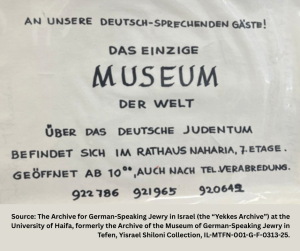
To attract and welcome visitors, a sign in German was hung on the doors of the town hall, proudly announcing:
TO OUR GERMAN-SPEAKING VISITORS!
THE ONLY
MUSEUM
IN THE WORLD
ABOUT GERMAN JEWRY
IS IN NAHARIYA CITY HALL, 7th FLOOR.
OPEN FROM 10:00, ALSO BY PRIOR TELEPHONE ARRANGEMENT.
PHONE: 922 786 · 921 965 · 920 642
A sign about the museum, hung on the doors of Nahariya’s municipally building, circa 1970–1990.
Initially attracting local Yekkes, the museum gradually gained broader recognition, drawing visitors from across Israel as well as delegations from Germany. By the early 1990s, however, Shiloni, then advanced in age, became increasingly concerned about the museum’s future: neither the Nahariya Municipality nor national bodies associated with the German-Jewish legacy expressed willingness to support it.
A fortuitous encounter with a museum visitor introduced Shiloni to the Yekke industrialist Stef Wertheimer (1926-2025), founder of Tefen Industrial Park. In 1993, the museum’s holdings were transferred to Tefen, where it reopened under the direction of Ruti Ofek, with Nili Davidson appointed to found the Archive which was then established. Shiloni remained actively involved. In 2003, a formal partnership was established with AICEO, and the museum and Archive re-opened for visitors a few years later. Following Wertheimer’s family withdrawal of financial support in 2021, the museum and Archive were transferred to the University of Haifa, with the support of, among others, the German and Austrian governments. The museum was reconstructed within the Hecht Museum, and the Archive integrated into the Haifa Center for German and European Studies (HCGES), with an official inauguration held in October 2025.
The Archive preserves a comprehensive array of documents belonging to more than 500 Jewish individuals and families who emigrated from German-speaking countries and Central Europe to Mandatory Palestine, primarily during the 1930s following the rise of Nazism. Its holdings span the late 19th century to the late 20th century, encompassing a diverse range of sources: letters, correspondence, postcards; diaries, photographs and albums, certificates, illustrations, rhymed poetry, plays, family history books and more. The catalogue is available online, and most of the collection has been digitized and accessible on Israeli’s national library website.
The Archive aspires to function as a “living archive,” continuously acquiring new family collections while expanding its holdings to include oral testimonies from second- and third-generation descendants. The collection newly arrived in Haifa will be accessible soon.
The Archive is committed not only to safeguarding historical documents and maintaining close ties with the donating families but also fostering connections with the Yekkes community more broadly. Its mission extends beyond the mere documentation of historical materials to preserve the sense of a community.
By virtue of its location within the University’s Haifa Center for German and European Studies, the Archive gains an additional dimension, linking the Yekkes community with academia and bringing its history to audiences beyond the community itself. Courses on the oral history, heritage, and archival materials of the Yekkes are incorporated into the curriculum, with students conducting interviews with second- and third-generation members and drawing on the Archive’s holdings for research projects. In this way, the Archive functions not merely as a repository of documents but as a living center of memory, scholarship, culture, and identity.
📩 Donate family materials and help us preserve Yekkes heritage, or subscribe to our mailing list for updates: AGSJI@univ.Haifa.ac.il