Between Continuity and Transformation: German-speaking Jews in Palestine and Israel
(October 28, 2025 | University of Haifa)
The report was first published in German on the platform H-Soz-Kult—Communication and information services for historical research (Humboldt-University Berlin): Cyra Sommer, conference report: Between Continuity and Transformation: German-speaking Jews in Palestine and Israel, in: H-Soz-Kult, 14.02.2026, https://www.hsozkult.de/conferencereport/id/fdkn-160453.
After many years of uncertainty, the legendary Museum of German-speaking Jewry—commonly known as the “Yekkes Museum”—was ceremonially reopened on October 28, 2025, in a new location. Following the former museum’s closure in Tefen in 2021 due to the lack of long-term funding, a newly constructed wing of the Hecht Museum at the University of Haifa is now dedicated to the heritage of German-speaking Jews in Israel. The so-called “Yekkes” were individuals who, for the most part, emigrated in the 1930s from National Socialist Germany and Europe to what was then the British Mandate of Palestine, and who built new lives in the emerging State of Israel.
The origins of the museum can be traced back to the initiative of an Israeli of German descent: Israel Shiloni (1901–1996). In the early 1970s, with personal dedication and almost missionary zeal, Shiloni established a small museum in Nahariyah (a town founded by German-Jewish immigrants) with the aim of honoring the achievements of German Jewry. In the 1990s, with the support of the entrepreneur Stef Wertheimer (1926–2025), also originally from Germany, the museum became part of a larger museum complex in the industrial park of Tefen. Until its closure in 2021, it introduced Israeli, German, and international visitors alike to the history and culture of the Yekkes.
On the occasion of the reopening, the Haifa Center for German & European Studies (HCGES)—which since 2021 hosts the Archive for German-speaking Jewry in Israel (AGSJI), originating from the museum—organized an academic conference entitled “Between Continuity and Transformation: German-speaking Jews in Palestine and Israel.”
In his welcoming remarks, HCGES director Stefan Ihrig (Haifa) only briefly alluded to the museum’s eventful history and to the long, at times arduous struggle to secure (German) funding in order to preserve this unique institution and its archive. Above all, he expressed his gratitude to the long-standing curator of the Tefen museum, Ruthi Ofek, who was repeatedly acknowledged with appreciation throughout the conference.
Panel I: Cultural Practices of Yekkes in Mandatory Palestine/Israel
The thematic opening was provided by a panel moderated by Moshe Zimmermann (Jerusalem) on the cultural history of the Yekkes in Palestine and Israel, approaching the subject from four distinct perspectives. In his lecture, Joachim Schlör (Southampton) evoked the now largely vanished worlds of German-Jewish Israelis, who created German-speaking cultural enclaves in cities such as Tel Aviv, Jerusalem, and Haifa—through cafés, restaurants, libraries, and literary salons. Drawing on his research on the salon of Ernst and Nadja Taussig, which between 1941 and 1991 brought together many leading figures of the emigrated German-speaking cultural and literary milieu (Arnold Zweig, Max Brod, Stella Kadmon, among others), Schlör reflected on the productive interplay between personal encounter and scholarly inquiry, which has also shaped his own work. For a long time, research into German-Jewish history in general, and into the Yekkes in Israel in particular, was largely carried out by German-Jewish emigrants themselves. Since the 1990s, however, a new generation of scholars—from Germany as well as from Israel—has given the field renewed momentum and introduced new research questions.
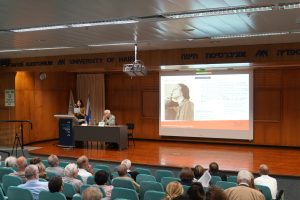
Esther Gardei (Berlin) presented findings from her work on the network surrounding the journal Orient, a relatively short-lived publication of socialist and antifascist emigrants in Palestine during the 1940s. Examining the journal through the lenses of “post-Zionism” and “tolerance of ambiguity,” Gardei highlighted writers such as Wolfgang Yourgrau and Katinka Küster-Ginsberg. These figures, she argued, have so far received little attention in scholarship on Orient in favor of more prominent personalities, despite their considerable importance for the journal and its network.
Stefan Litt (Jerusalem), offering insights into the collection history of what is today the National Library of Israel, introduced the audience once again to well-known German-Jewish intellectuals such as Gershom Scholem and Martin Buber, Max Brod and Franz Kafka, Else Lasker-Schüler and Stefan Zweig. Their literary estates entered the holdings of the National Library not least because of the close personal and institutional entanglements of German-Jewish immigrants with the leading universities, archives, and cultural institutions of the emerging State of Israel.
The first panel concluded with a contribution on German-Jewish-Israeli sports history. Udi Carmi (Tel Hai) spoke about the athlete Aliza Wirtz, who was born in Munich in 1920 and emigrated to Palestine in 1933. In the early 1940s she became the first woman to swim across the Sea of Galilee in record time, turning into an icon of what would later become the Zionist-inflected “Cross-Kinneret Swim.”
Film Talk: From the Archive to the Screen—Fragments of a Vanished World and the Formation of Identity through the Meyer Family Collection
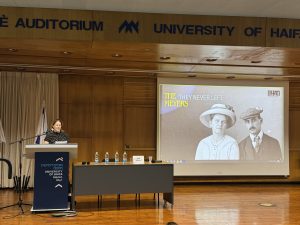
The interweaving of personal encounter, the initiative of individual Yekkes to document their own family histories, and academic research—already evident in the lectures—was vividly demonstrated by a film in progress by filmmaker Anat Vogman (Haifa), from which the audience was shown excerpts for the first time. Vogman has worked extensively with the estate of Otto and Gertrud Meyer, now held in the AGSJI. The couple fled Germany in 1937 with their three children to Nahariyah, and their son Andreas Meyer continued to preserve and expand the family archive. The academically informed film, emphasizing the fragmentary nature of historical transmission, reconstructs the couple’s life through numerous photographs and textual testimonies, weaving together multiple narrative layers and interpretations of family history in a deeply moving manner.
Panel II: Re-Encounters with Germany
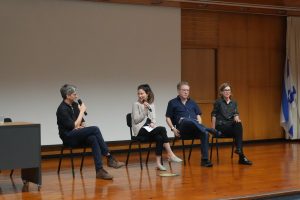
The second panel, chaired by Marc Volovici (Haifa), focused on the complex and ambivalent relationship of former German Jews to postwar German society. How conflict-ridden, burdened, and fragile this relationship initially was after the rupture of the Shoah was vividly illustrated by Caroline Jessen (Leipzig) through the example of the well-known publisher, merchant, and collector Salman Schocken. Schocken, who had established a unique library in Jerusalem after his emigration, negotiated in the 1950s with German cultural institutions and ultimately exchanged the coveted manuscripts of his Novalis collection for Hebrew manuscripts located in Germany. This exchange revolved around questions of the rightful place of material heritage, while also echoing a much older debate—dating back to the nineteenth century and carried out under entirely different conditions after 1945—over the compatibility of “Germanness” and “Jewishness.”
Building on this, David Witzthum (Mevaseret Zion), a long-time journalist and expert on the history of the Yekkes, explored the sharply contested postwar debate among former German Jews about the existence—or non-existence—of “another” or a “new Germany.” As Witzthum demonstrated through the example of numerous intellectuals (Hannah Arendt, Arnold Zweig, Leo Baeck, among others), this debate also served as a forum for negotiating questions of their own cultural belonging to the German cultural sphere.
The notion of a kind of “dual belonging” of former German Jews between Germany and Israel was also addressed by Irit Chen (Haifa), academic director of the Archive for German-speaking Jewry in Israel at the HCGES. Using the example of the Israel Purchasing Mission, which emerged from the Luxembourg Agreement and operated from Cologne to procure German goods on behalf of the State of Israel, Chen reflected on the delegates’ renewed encounters with Germany and Germans. She emphasized the complexity and ambiguity of their mission, caught between official state assignment and deeply personal experience—ultimately contributing to the difficult path toward diplomatic relations between the Federal Republic of Germany and the State of Israel.
Roundtable Discussion: Between Berlin and Ben-Yehuda Straße—Yekkes, Archives and the Future of Research on German-Jewish History
The conference concluded with a roundtable discussion in which Daniel Mahla (Haifa) spoke with leading experts in German-Jewish history and directors of major research institutes about current challenges and opportunities in the field. The panelists emphasized, on the one hand, the particularities of the discipline, whose development was undoubtedly shaped by the personal commitment of many German-Jewish emigrants—in Israel, but also in Great Britain, the United States, and beyond. On the other hand, Guy Miron (Jerusalem) argued for a stronger opening of the field and urged caution in the scholarly use of the term “Yekkes.” Research into the history of German Jews in general, and their experiences in Israel in particular, he noted with the other panelists’ broad agreement, offers insights for neighboring disciplines and broader themes such as migration and knowledge transfer. This relevance for younger generations and scholars with diverse biographical and academic backgrounds, as Gisela Dachs (Jerusalem) remarked from her experience with students, gives rise to new and emerging questions.
That German-Jewish history and its aftermath remain far from fully explored even after decades of collecting, archiving, and research was underscored by Kim Wünschmann (Hamburg), Gideon Reuveni (Brighton), and Irene Aue-Ben-David (Jerusalem), who spoke of newly emerging and still untapped family estates and documents at their institutes. Particularly with regard to the history of ‘ordinary people,’ whose study has gained increasing attention in recent decades, significant desiderata remain. This concluding reflection was important, as many conference contributions also drew heavily on prominent figures and could largely be categorized as intellectual history. Wünschmann also pointed to new technical possibilities for networking and digitization at the Hamburg Institute for the History of German Jews (IGDJ), whose productive and ethical use requires a critical approach and professional guidance.
A revealing exchange also took place regarding the advantages and limitations of using the term Holocaust in reference to the history of German Jews. According to Miron, it is not always appropriate and may follow a certain logic of scholarly and public attention. Differentiating between German-Jewish historical research and Holocaust research seems justified, particularly in light of the distinct institutional histories of archives and research institutes, and their conscious demarcation from one another. Here, too, the history of the Yekkes Museum itself resonates, as its founder Israel Shiloni explicitly wished to honor German Jewry before the Shoah. At the same time, as the conference contributions clearly demonstrated, the two fields cannot be entirely separated, since the history—and above all the legacy—of the Holocaust is reflected in many ways in German-Jewish history and its study. Despite this entanglement, Irene Aue-Ben-David emphasized, engagement with the history of the Yekkes opens perspectives that extend far beyond the history of the Holocaust in the narrower sense.
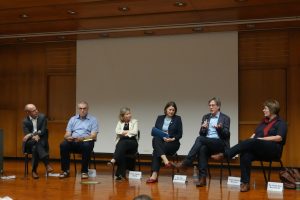
Overall, the conference created an important forum connecting leading scholars from Israel and Germany with early-career researchers and interested participants, reflecting on existing scholarship while providing new impulses. The dialogue between past and present, as well as between different generations, was highly productive. Equally significant was the distinctive, if occasionally tension-filled, yet necessary dialogue between academic scholarship and the Yekkes community itself, which has repeatedly sought rightful recognition of its historical experience and that of its parents and grandparents. The festive reopening of the museum, which began modestly more than five decades ago through the initiative of Israel Shiloni and is today supported by the Association of Israelis of Central European Origin, provided a fitting conclusion to the conference.