

Portraits of the Eastern Front:
Hermann Struck’s Encounters with Erich Ludendorff during World War I
Chen Shapira
This blog post was written under the guidance of Dr. Irit Chen within the framework of the M.A. course “The Historian and the Archive,” offered by the Haifa Center for German and European Studies at the University of Haifa.
In his wartime diary, Hermann Struck, a devout German-Jewish artist who volunteered for service in the German army during World War I, recorded an encounter with General Erich Ludendorff on the Eastern Front. Read in retrospect, this interaction encapsulates a historical paradox: Struck, a patriotic German Jew, maintained cordial relations with a commander who following’s Germany’s defeat in World War I, would embraced explicit antisemitic views and become closely associated with the ultranationalist and antisemitic forces that helped pave the way for the rise of Nazism.
Hermann Struck was born in Berlin in 1876 to an Orthodox Jewish family. He was a professional printmaker known for his portraits of prominent figures, including Theodor Herzl and Sigmund Freud. Alongside his artistic career and active involvement in the Zionist movement, Struck maintained a strong sense of German patriotism. At the outbreak of World War I, at the age of 38, he volunteered for military service, joining the ranks of the 90,000 Jews who served the German Empire. This decision placed him on the Eastern Front, setting the factual stage for his direct interactions with the German High Command.
Due to his artistic talents and his fluency in Yiddish, Struck was deployed in July 1915 to the Eastern Front under Ober Ost, the military administrative body established in late 1914 by Paul von Hindenburg to govern the vast territories occupied by the German Empire in Eastern Europe during the war. Initially serving as a censor and translator, he was later promoted to the rank of officer and appointed in charge of Jewish affairs. His service brought him into direct, unmediated contact with the masses of Eastern European Jews (Ostjuden). This encounter left a profound anthropological and cultural impression on him. This encounter was central to a broader discourse among German-Jewish intellectuals and organizations, such as Committee for the East (Komitee für den den Osten—KfdO) who viewed Yiddish as a German dialect and consequently perceived Eastern European Jews as “pioneers of Germanness” (Pioniere für das Deutschtum) within the Slavic East. Struck found himself in a complex mediating role. He operated out of a deep dual commitment, remaining loyal to his German commanders as a soldier while feeling a deep kinship with his impoverished Jewish brethren.
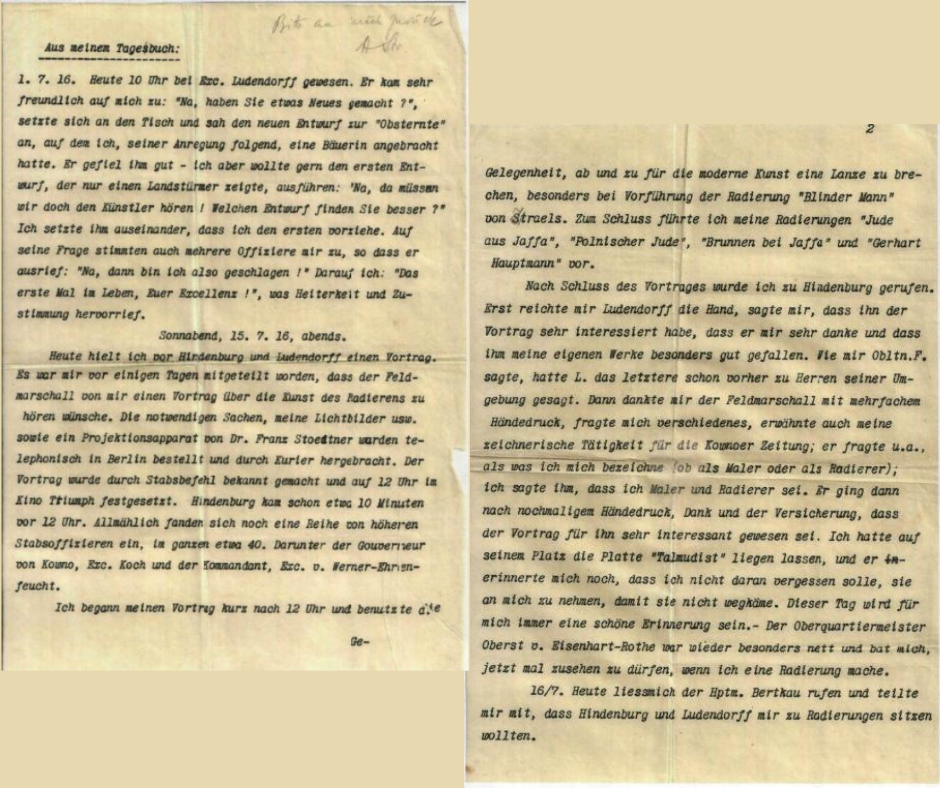
Excerpts from Struck’s personal diary from this period, preserved at the Archive for German-speaking Jewry (the “Yekkes Archive”), offer a rare historical testament to the complex dynamic between a Jewish artist and the German High Command. This account, however, relies entirely on Struck’s own subjective documentation and his personal interpretation of the encounter. In an entry dated July 1, 1916, Struck recorded what he perceived as a surprisingly relaxed meeting with General Erich Ludendorff. According to Struck, Ludendorff approached him amicably and asked if he had created anything new. Ludendorff’s question, which presupposes a familiarity with Struck’s artistic work, suggests that this was likely not their first encounter. During their meeting, an artistic debate arose regarding a sketch for a piece titled “Fruit Harvest”: Ludendorff suggested including the figure of a peasant woman, while Struck preferred his initial version featuring only a militiaman. Ludendorff humorously turned to his officers, noting that they must listen to the artist, and admitted he was “defeated”. Struck playfully replied, “For the first time in your life, Your Excellency!”, a remark that, as Struck documented, provoked amusement among those present, highlighting a dynamic that stood in stark contrast to Ludendorff’s notoriously rigid and authoritarian persona.
Two weeks later, on July 15, 1916, Struck was invited to deliver a lecture on the art of etching to Field Marshal Paul von Hindenburg and Ludendorff. The lecture took place at the Triumph Cinema in the presence of approximately 40 senior staff officers. Notably, while presenting before the German military elite, Struck boldly showcased works featuring distinct Jewish and Levantine motifs, such as “Jew from Jaffa,” “Polish Jew,” and “Well near Jaffa”. At the conclusion of the lecture, Struck received high praise from both commanders, who expressed great interest in his work and even agreed to sit as models for his portraits the following day. Hindenburg even displayed a surprising attention to detail, reminding Struck not to forget his etching plate titled “Talmudist,” which the artist had accidentally left at his seat.
These engagements, however, served as more than just artistic showcases; they also created opportunities for revealing exchanges about the meaning of Struck’s work. The portfolio that impressed Hindenburg and Ludendorff during the lecture formed part of a larger body of work Struck produced during his service on the Eastern Front, including numerous portraits of soldiers and prisoners of war (POWs), among them many Jews he encountered. His artistic documentation of POWs revealed a sharp ideological divide: whereas the military establishment sought to validate racist typologies, Struck rejected simplistic stereotypes.
This contrast is particularly evident in Struck’s encounters with Ludendorff. While examining Struck’s portfolio of POW portraits, Ludendorff interpreted the images through the lens of racial ideology, attempting to classify individual according to perceived physiognomic characteristics. His remarks to Struck, such as his claim that blonde and dark-haired Poles represented fundamentally different racial groups associated with distinct social hierarchies, reflected a broader effort to validate contemporary racial and antisemitic assumptions. A conflict of gazes emerged around his Jewish subjects. Whereas Ludendorff viewed these portraits as tools to reinforce his racial worldview, Struck approached them with authentic anthropological curiosity. He depicted Eastern European Jews not as caricatures, but as dignified individuals, resisting the reductionist portrayals demanded by the military leadership.
The historical dissonance emerging from Struck’s diary becomes overwhelmingly clear when examining the subsequent political paths of Ludendorff and Hindenburg. The very commanders who expressed cultural appreciation for a Jewish artist in 1916 became integral to the future catastrophe of Germany and European Jewry. It is significant to note that in his wartime records, Struck did not perceive or document any overt antisemitism directed toward him by Ludendorff during their interactions. This cordial personal rapport stands in sharp contrast to the radical ideologies Ludendorff would later champion. Following Germany’s defeat, he became one of the primary architects of the “Stab-in-the-back myth” (Dolchstoßlegende), the false conspiracy theory blaming Jews and internal traitors for the German army’s capitulation. Ludendorff translated his virulent racism into fervent support for Adolf Hitler in his early days, participating alongside him in the 1923 Munich Beer Hall Putsch.
Although Ludendorff later suffered a political defeat and fell out with Hitler, his subsequent view of Hitler as a “danger to Germany” was by no means rooted in an opposition to Nazi geopolitics or a repudiation of antisemitism; Ludendorff held onto his radical, extreme antisemitic views until his final days.
The contrasting legacies of Struck and Ludendorff embody the tragic collapse of the German-Jewish symbiosis. While Struck immigrated to Palestine in 1922 to pursue his Zionist vision, his personal rapport with Ludendorff failed to mitigate the General’s deep-seated prejudice. The diary entries therefore offer a poignant historical paradox: they capture a moment of recognition and familiarity between a Jewish artist and a German commander shortly before the collapse of the world that had made such an encounter possible.
Archive for German-speaking Jewry in Israel, Hermann Struck Collection, IL-MTFN-001-G-F-0353-2.
📩 Donate family materials and help us preserve Yekkes heritage, or subscribe to our mailing list for updates: AGSJI@univ.Haifa.ac.il