

A Journey to Palestine: The 1938 Diary of Albert Goetz
Chimeziem Ezebuilo
This blog post was written under the guidance of Dr. Irit Chen within the framework of the M.A. course “The Historian and the Archive,” offered by the Haifa Center for German and European Studies at the University of Haifa.
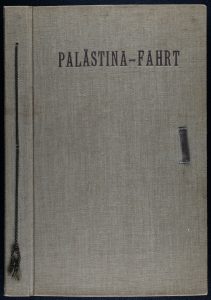
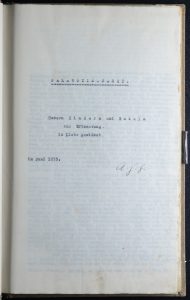
In June 1938, Albert Goetz, an insurance agent from Zehlendorf, Berlin, picked up a pen and opened a notebook. He had just returned from a journey to Mandatory Palestine, where he had visited his children, who had immigrated there a few years earlier, and met his grandchildren for the first time. Upon the notebook’s pages, he recorded the memories of his voyage, seeking to preserve the experience of this long-awaited family reunion. On the first page, he inscribed: “To our children and grandchildren, in remembrance. Dedicated with love, June 1938” (“Unsern Kindern und Enkeln zur Erinnerung. In Liebe gewidmet im Juni 1938”).
Albert Goetz was born in Berlin on January 30, 1880, and worked for the Hilfe insurance company. His first wife passed away, and he later married Grethel, born on July 20, 1899, whom he affectionately called “Schmuddelpuddel“. They had no children together, but Albert had three children from his first marriage: two sons, Georg and Richard, and a daughter, Ingeborg. In the 1930s, all three children immigrated to Palestine and Hebraized their names. Georg became Gershon and settled in Rishpon with his wife Dora, where their daughter Naomi was born. Richard became Zvi and lived in Herzliya with his wife Alice, and their sons Uri and Reuven, who were born in Palestine. Ingeborg became Chana.
By the time Albert visited Palestine, the family had been separated for four years. His children had left Berlin in 1934, and he and Grethel remained behind, watching as restrictions on Jewish life in Germany piled up. Travel became increasingly difficult. The state tracked all their money, and British authorities in Palestine had placed strict immigration rules. To leave, even just to visit, Albert and his wife had to jump through countless bureaucratic hurdles. He noted each requirement with careful detail: the approval from the Devisenstelle, the Foreign Exchange Office, to move funds; the deposit of 800 Marks per person for the British consul; the need for valid travel documents; the fact that Grethel’s passport was expiring in May 1938. The journey was made possible only after a generous aunt of Grethel provided the necessary funds, as they were initially unable to pay the deposit.
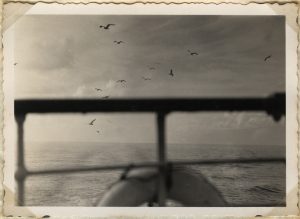
On February 26, 1938, Albert and Grethel left Berlin early in the morning, accompanied by the blessings of relatives and friends. At the Swiss border, a customs official examined their passports and asked if they had any foreign currency. Albert described the inspection as simpler and more conscientious than one could imagine. They spent a night in Lausanne with a relative named Ruth, who had been staying in a sanatorium. They then continued to Marseille, where they stayed at the Hotel Bristol. On March 1, they boarded the SS Champollion and crossed the Mediterranean. He kept a record of the trip like a sailor, noting the sea conditions, the weather, and the sight of Stromboli rising out of the water. On March 5, they stopped briefly in Alexandria, visiting Pompey’s Pillar, a sphinx, the botanical and zoological gardens, and the Mahmoudieh Canal.
On March 6, 1938, they arrived at the port of Haifa. At eleven in the morning, they saw Mount Carmel on the horizon with the Arab city of Acre to the left. Together with the other passengers, they looked at the harbor, the city, and the slopes of the Carmel, and decided unanimously that it was the most beautiful city they had ever seen. After the ship anchored, they rowed ashore. A relative helped them with customs. They hurried to the harbor exit where, after four years, they embraced their sons Georg and Richard. Albert later learned that Georg had whispered to his brother, “father has gone grey”, (“Vater ist grau geworden“) – a brief remark that reflects not only a physical change but also the passage of time and the emotional toll of the years. The diary reveals the profound relief of that moment: the exhaustion from months of paperwork, the stress of the journey, and underneath it all, the overwhelming thrill of finally meeting the grandchildren he had never held.
At Georg’s home in Rishpon, they met their granddaughter Naomi for the first time. Albert wrote that their expectations were fulfilled beyond measure, better than all the stories and photographs. Naomi received from Albert and Grethel a doll and a handbag, and would not let them go. She understood German but answered only in Hebrew. Every evening, Georg sang Hebrew songs with Naomi that she had learned in kindergarten, which they then translated into German for the grandparents. In Herzliya, Albert and Grethel spent time with their son Richard and his family. Richard’s wife Alice was nursing their infant son Uri, who was just three months old. The extra food Albert and Grethel brought with them at their own expense helped Alice produce more milk for him, and the previously restless baby became quiet and slept through the night. Albert recorded the joyful moment when Reuven, who had only toddled along the fence and chairs, suddenly began to walk independently. He could not decide who was more excited, the father or the grandfather. Richard repeatedly shouted that they should film the moment.
Herzliya and Rishpon were nothing like Berlin. They were simple settlements where people worked with their hands. Albert watched his sons harvest citrus and haul sand on camels for building materials. These were men who had worked in offices in Berlin, now working the land in Palestine. Before settling in Rishpon, Georg and Dora had first joined the Kvutzat Hakovesh near Kfar Saba. During the Arab Revolt of 1936, they endured thirty-nine fire attacks on their settlement, which resulted in deaths. When they left the group, they had to leave behind their entire household from family silver to their cooking utensils. Because of prolonged malnutrition, Georg became seriously ill and was unable to work for a year. Much of the family’s limited income was spent on daily necessities and medical care. When they established their new home, they could afford only the bare essentials: a double couch, one table, two stools, some dishes, and two wardrobes, one of which Georg built himself. Albert reflected on this with astonishment, struck by the contrast between Georg’s former life as a lawyer and journalist and his new reality.
Despite the warmth and joy of the visit, the political and security tensions were present. For example, Albert saw armed police guards on buses traveling between Tel Aviv and Jerusalem. On March 16, 1938, they visited Jerusalem in pouring rain. They toured the Old City, including the Via Dolorosa, the Western Wall, the Jewish quarter of Mea Shearim with its ancient style housing, and the Mizrachi quarter. They were not allowed to enter the Church of the Holy Sepulcher due to dilapidation, nor the Dome of the Rock (the “Omar Mosque”) because it was a Muslim holy site. From Mount Scopus, eight hundred meters high, they had a spectacular view of the Dead Sea, four hundred meters below sea level. It was so cold that Albert could barely hold his binoculars. Walking through the Jaffa Gate and standing at the Western Wall, Albert described the ancient weight of the Old City alongside the modern reality of military checkpoints. Later that evening, after their departure from Jerusalem, Richard informed them that at seven o’clock a bomb had been thrown near the Jaffa Gate, wounding several people.
On March 30, 1938, Albert and Grethel left Mandatory Palestine and returned to Berlin despite the earnest pleas of family and friends that they stay. Looking back on the journey after arriving home, Albert wrote his diary retrospectively. He explicitly stated that more than two months had passed since their return and that it gave him great pleasure to recall all the small and tiniest details of the journey while writing. The return journey itself was not without difficulty: due to missed connections, they had to travel via Lyon and, unexpectedly, take a Pullman luxury train, which cost them extra. During a stopover in Geneva, they visited Mont Salève, where Grethel remarked that if they had not seen their children and grandchildren in Palestine, she would have declared that mountain view the most beautiful part of the entire trip.
The diary ends with Albert’s reflection on the question that had stood before the family since 1934: will they see each other again? Albert recognized that question stood before them anew, more threatening than before. Five months later, the November Pogrom (known as the Kristallnacht) took place.
In 1940, Albert sent a postcard from the Netherlands to his eldest son Georg. He wrote that he was getting on the train and traveling to a place from which no one returns. Albert and Grethel were deported to Auschwitz, where they were murdered. Just as Albert had wished, the diary preserved the memory of a reunion. Although written to celebrate a joyful encounter, the diary later became a valuable historical record of a family’s shared life and of the enduring connections that shaped it.
Archive for German-speaking Jewry in Israel (the “Yekkes Archive”), Albert Goetz collection, IL-MTFN-001-G-F-0418.